Leadership with Vision: Vinit Dungarwal’s Journey of Purpose, Innovation and Excellence
Introduction
Great organisations are rarely built through technical knowledge alone. They are shaped by leaders who can see possibilities before others recognise them, remain focused during uncertainty and transform ideas into practical results.
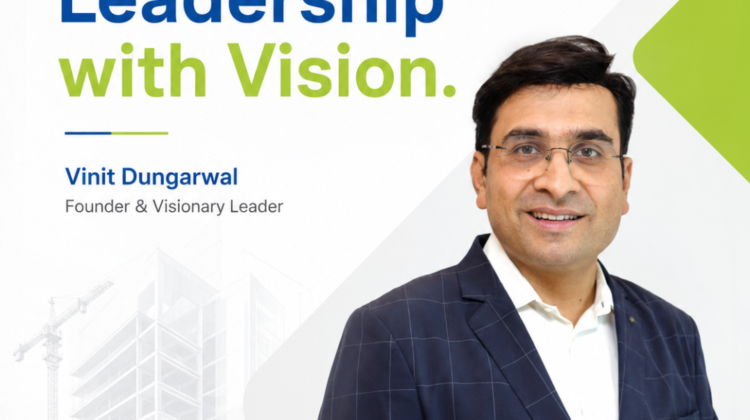
For Vinit Dungarwal, Founder and Visionary Leader of AMs Project Consultants Pvt. Ltd., leadership has always been about more than holding a position. It is about creating direction, building trust, encouraging innovation and delivering meaningful value through every project and business relationship.
His professional journey represents the combination of engineering expertise, construction management knowledge, financial understanding, entrepreneurship and conscious leadership. These qualities have helped him build AMs as a project development and consultancy organisation focused on disciplined planning, effective execution and long-term client success.
Vinit’s story is not simply about starting a company. It is about creating an organisation with purpose, developing resilience through challenges and building a culture where technical excellence and human values work together.
Building a Strong Foundation Through Education
A leader’s vision becomes more effective when it is supported by knowledge and practical understanding.
Vinit Dungarwal developed his professional foundation through a diverse educational background that connects engineering, project management and finance.
With a Bachelor of Engineering in Civil Engineering, he gained a detailed understanding of structures, construction systems, materials, technical coordination and project execution.
He further strengthened his industry knowledge through a specialisation in Construction Management from NICMAR, the National Institute of Construction Management and Research. This helped him develop a broader understanding of planning, scheduling, contracts, procurement, quality control, cost management and construction operations.
His Diploma in Finance from ICFAI added another important dimension to his capabilities. Construction projects are not managed through engineering decisions alone. Every design choice, procurement strategy and execution decision has a financial impact.
By combining engineering, construction management and finance, Vinit developed the ability to examine projects from multiple perspectives.
This multidisciplinary knowledge became one of the key strengths behind the development of AMs.
The Beginning of an Entrepreneurial Journey
Entrepreneurship often begins with an idea, but building a sustainable organisation requires much more.
It requires courage, patience, planning, adaptability and the willingness to take responsibility for every outcome.
As a first-generation entrepreneur, Vinit Dungarwal entered the business world without the advantage of an established organisational legacy. He had to create systems, build relationships, earn trust and demonstrate value through consistent performance.
The early stages of AMs were supported by a carefully considered approach that included a 100-day proof of concept and a 1,000-day business plan.
This structured beginning reflects an important principle of Vinit’s leadership philosophy: a vision becomes meaningful only when it is supported by a practical execution plan.
Rather than depending on ambition alone, the foundation of AMs was built through validation, planning, learning and continuous improvement.
Over time, this approach helped the company grow into an organisation providing consulting, construction and collaboration services for diverse business and project requirements.
Leadership Is About Direction, Not Control
Traditional leadership is sometimes associated with authority and control. However, modern businesses require a different approach.
Teams perform better when they understand the purpose behind their work, have clarity about their responsibilities and feel trusted to contribute their expertise.
For Vinit, leadership is about providing direction while allowing people to grow.
A strong leader does not attempt to make every decision independently. Instead, the leader creates an environment where specialists can communicate openly, identify risks early and work together towards a shared objective.
In the construction and project management industry, this approach is especially important.
Every project involves multiple stakeholders, including:
- Clients
- Architects
- Engineers
- Project managers
- Contractors
- Vendors
- Government authorities
- Site teams
- End users
Each stakeholder has different priorities and responsibilities. Without effective leadership, these differences can create delays, disputes and costly misunderstandings.
Visionary leadership connects these teams by establishing common goals, clear communication systems and measurable standards of performance.
Combining Technical Expertise with Business Understanding
One of Vinit Dungarwal’s key strengths is his ability to connect technical project requirements with business objectives.
A project may be technically successful but commercially inefficient. Similarly, a project may appear financially attractive but fail to deliver the required quality, performance or long-term value.
Effective project leadership must balance both areas.
This means asking important questions such as:
- Is the project aligned with the client’s business goals?
- Is the budget realistic?
- Are design decisions practical and cost-effective?
- Have construction risks been properly evaluated?
- Is the project schedule achievable?
- Are quality and safety standards clearly defined?
- Will the completed asset provide long-term value?
- Are the client’s investments being protected?
This integrated approach allows projects to be managed not only as construction assignments but as business investments.
At AMs, the focus is therefore not limited to completing physical work. It extends to ensuring that planning, design, procurement, execution and handover support the client’s wider objectives.
The Importance of Spiritual Thinking in Leadership
An important and distinctive aspect of Vinit’s leadership philosophy is his belief in spiritual thinking.
Spiritual thinking does not mean separating oneself from business realities. Instead, it means developing awareness, balance, responsibility and a deeper understanding of how decisions affect people and organisations.
Vinit believes that spirituality should not be reserved for the later stages of life. It can be embraced from an early age and applied meaningfully in professional leadership.
In practice, conscious leadership may involve:
- Remaining calm during pressure
- Making decisions with clarity
- Listening before responding
- Treating people with respect
- Taking responsibility for outcomes
- Balancing ambition with ethics
- Looking beyond short-term gains
- Building trust through consistent actions
Construction and entrepreneurship both involve uncertainty. Projects may face unexpected site conditions, financial pressure, delayed approvals, coordination problems or market changes.
A leader who reacts impulsively can increase confusion. A leader who remains aware, thoughtful and focused can guide the team towards a practical solution.
Spiritual thinking therefore becomes a source of stability, especially during difficult situations.
Resilience as a Leadership Strength
Every entrepreneurial journey includes challenges.
There are periods when plans do not work as expected, opportunities take longer to develop or external circumstances create uncertainty.
Vinit’s journey as a first-generation entrepreneur required him to navigate many difficult situations while continuing to move forward.
His ability to overcome adversity has played an important role in the development of AMs.
Resilience in leadership does not mean ignoring problems or pretending that difficulties do not exist. It means:
- Understanding the situation honestly
- Identifying what can be controlled
- Learning from the experience
- Making necessary changes
- Continuing with greater clarity
This mindset helps organisations treat challenges as opportunities for improvement rather than permanent setbacks.
In project management, resilience is equally important. Construction projects rarely progress exactly as originally expected. Successful teams are those that recognise changes early, assess their impact and implement corrective action without losing sight of the final objective.
Creating the “Glocal” Approach
Modern businesses operate in an increasingly connected environment.
Clients expect access to international knowledge, innovative practices and global quality standards. At the same time, every project must respond to local regulations, market conditions, cultural expectations, labour availability and site realities.
Vinit’s visionary approach contributed to the introduction of the “Glocal” concept within AMs.
The concept combines:
- Global expertise
- Local knowledge
Global expertise helps organisations benefit from international benchmarks, new technologies, structured systems and proven project management practices.
Local knowledge ensures that these ideas are applied realistically within the actual project environment.
This balance is important because solutions cannot simply be copied from one market and applied to another without adaptation.
A successful consultancy must understand both international possibilities and local practicalities.
The Glocal approach allows AMs to deliver solutions that are informed by wider industry knowledge while remaining relevant to each client and project location.
Innovation with Practical Purpose
Innovation is often associated with technology, but meaningful innovation is not limited to adopting new software or digital tools.
It can also involve improving processes, simplifying communication, reducing waste, identifying risks earlier and helping teams make better decisions.
For Vinit, innovation must create practical value.
In construction and project management, useful innovation may include:
- Digital project monitoring
- Integrated reporting systems
- Building Information Modelling
- Data-based cost control
- Improved documentation
- Digital drawing management
- Structured risk registers
- Collaborative planning platforms
- More efficient procurement methods
- Sustainable design practices
However, technology alone cannot solve every project problem.
A digital system will not be effective if project responsibilities are unclear. Advanced software will not improve performance if data is inaccurate or teams do not communicate.
Visionary leadership therefore evaluates technology based on how effectively it supports people, processes and project outcomes.
The objective is not to use innovation for appearance. It is to use it to increase transparency, improve efficiency and strengthen decision-making.
Building a Culture of Excellence
A company’s reputation is shaped by the standards it maintains consistently.
Excellence is not created through one successful project or one strong presentation. It is built through everyday discipline.
This includes:
- Responding professionally
- Maintaining accurate documentation
- Monitoring quality
- Respecting timelines
- Communicating risks honestly
- Managing changes carefully
- Supporting team development
- Learning from completed projects
- Focusing on client value
Under Vinit’s leadership, AMs has developed its identity around professional execution and dependable project delivery.
A culture of excellence requires everyone in the organisation to understand that small actions matter.
An inaccurate report, delayed response or missed inspection may appear minor, but each can affect trust and project performance.
Leaders influence culture through their own behaviour. When leadership values quality, accountability and continuous improvement, these standards gradually become part of the organisation’s working style.
Collaboration as a Business Principle
Construction is a collaborative industry.
No single person or organisation can successfully deliver a complex project independently.
The success of the client depends on consultants. Consultants depend on contractors and technical specialists. Contractors depend on vendors, site teams and timely decisions.
When stakeholders operate in isolation, the project becomes vulnerable to conflict.
Vinit’s leadership philosophy recognises collaboration as an essential part of project success.
Effective collaboration requires:
- Defined responsibilities
- Open communication
- Respect for specialist knowledge
- Timely information sharing
- Clear decision-making
- Transparent reporting
- Constructive problem-solving
Collaboration does not mean avoiding disagreement. Technical and commercial differences will naturally occur.
The purpose of collaboration is to address those differences professionally and keep the project focused on the best possible outcome.
Delivering Measurable Value to Clients
A consultancy must be evaluated through the value it creates.
Clients do not appoint project consultants only to receive reports or attend meetings. They expect guidance that protects their investment and improves project performance.
Meaningful consultancy value may include:
- Reducing project risks
- Preventing rework
- Improving cost visibility
- Supporting timely decisions
- Strengthening quality control
- Coordinating stakeholders
- Identifying schedule delays
- Managing procurement
- Improving documentation
- Supporting successful handover
Vinit’s leadership approach positions AMs as a project development organisation that focuses on original quality and organic results.
This means avoiding temporary or superficial solutions.
Long-term value is created when the consultant understands the client’s objectives, applies structured management systems and remains accountable throughout the project journey.
A Vision for the Future of Construction
The construction industry is changing rapidly.
Clients are becoming more informed. Projects are becoming more complex. Sustainability requirements are increasing. Digital tools are improving transparency, while cost and time pressures remain significant.
Future-ready leadership must respond to these changes without losing focus on fundamental principles.
The future of successful construction will depend on:
- Better early-stage planning
- Integrated design coordination
- Digital project control
- Sustainable construction
- Transparent cost management
- Stronger risk identification
- Skilled project teams
- Ethical leadership
- Collaborative decision-making
- Lifecycle thinking
Vinit Dungarwal’s vision reflects this balance between progress and discipline.
Technology will continue to change how projects are designed and monitored, but trust, accountability, quality and professional judgement will remain essential.
The organisations that succeed will be those capable of combining innovation with practical execution.
Lessons from Vinit Dungarwal’s Leadership Journey
Vinit’s journey offers several meaningful lessons for entrepreneurs, project professionals and future leaders.
1. Build Knowledge Across Disciplines
Technical knowledge becomes more valuable when combined with financial and management understanding.
2. Convert Vision into a Plan
A powerful idea requires structured execution, measurable milestones and continuous review.
3. Remain Conscious During Challenges
Calm and thoughtful leadership can transform difficult situations into opportunities for improvement.
4. Create Long-Term Value
Sustainable organisations are built by focusing on relationships, quality and meaningful results rather than short-term gains.
5. Combine Global Thinking with Local Understanding
The most effective solutions bring international knowledge into alignment with local realities.
6. Lead Through Action
Leadership credibility is created through consistency, responsibility and professional conduct.
7. Keep Learning
Every project, success and challenge provides lessons that can strengthen future performance.
Leadership with Vision
Leadership with vision is not simply about predicting the future.
It is about preparing an organisation to respond to that future with confidence.
It requires the ability to understand current realities while identifying new opportunities. It means guiding teams without limiting their potential. It means remaining committed to values even during pressure.
For Vinit Dungarwal, leadership combines entrepreneurship, engineering excellence, financial understanding, spiritual awareness and an ongoing commitment to creating value.
His journey with AMs demonstrates how a clear purpose, supported by disciplined execution, can build an organisation that continues to grow and contribute meaningfully to the construction and project management industry.
Conclusion
The story of Vinit Dungarwal is a story of vision supported by action.
From developing a strong technical and business foundation to building AMs as a project consultancy organisation, his journey reflects resilience, conscious leadership and a commitment to excellence.
His approach shows that successful leadership is not based only on authority or ambition. It is based on clarity, collaboration, responsibility and the ability to create opportunities for others.
As construction and project management continue to evolve, organisations will need leaders who can balance technology with human judgement, global ideas with local knowledge and business growth with professional values.
Through its focus on consulting, construction and collaboration, AMs Project Consultants Pvt. Ltd. continues to work towards delivering practical solutions, measurable results and long-term client value.
To learn more about Vinit Dungarwal, his leadership journey and the vision behind AMs, visit amsindia.co.in.